Climate Pollution Reduction Grant (CPRG)
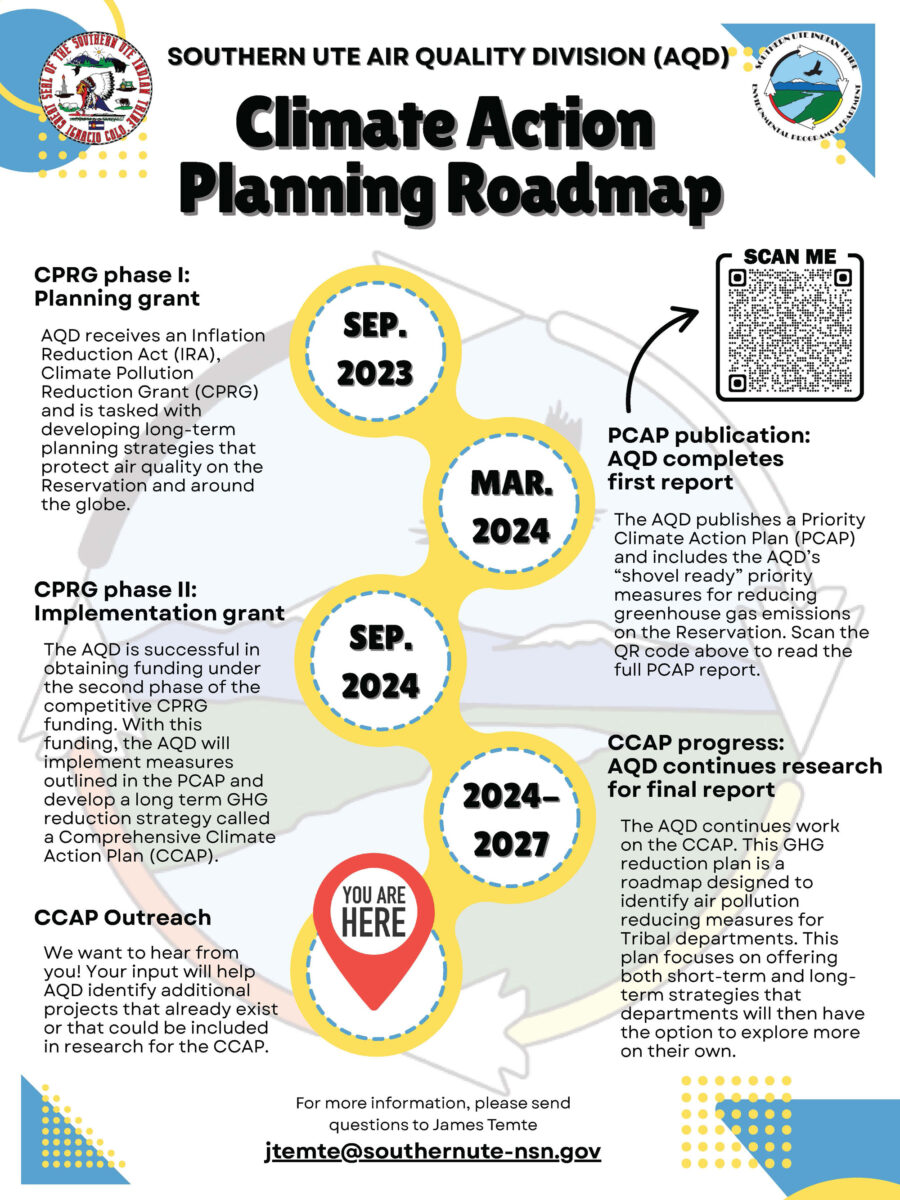
The Climate Pollution Reduction Grant (CPRG), created under the 2022 Inflation Reduction Act, was a nationwide competitive grant program available to states, tribes, and territories. Its purpose was to support the evaluation, development, and implementation of projects that reduce greenhouse gas (GHG) emissions and other harmful air pollutants. The CPRG was divided into two phases: the Planning Grant (Phase I) and the Implementation Grant (Phase II).
Phase I – Planning Grant
The Southern Ute Air Quality Division (AQD) received a CPRG planning grant in 2023 to develop long-term planning strategies to aid in the global challenge of mitigating human caused climate change and for maintaining healthy air quality on the Reservation. Required grant deliverables included a greenhouse gas emissions inventory Quality Assurance Project Plan, a GHG emissions inventory, a Priority Climate Action Plan (PCAP) and a Comprehensive Climate Action Plan (CCAP).
Priority Climate Action Plan (PCAP)
The PCAP, completed in 2024, outlines the AQD’s “shovel ready” priority measures for reducing GHG emissions on the Reservation. Later in 2024, the AQD was successful in obtaining funding under the second phase of competitive CPRG funding to implement specific measures outlined in the PCAP.
Comprehensive Climate Action Plan (CCAP)
The AQD is now developing a long-term GHG reduction strategy (2025-2050) for the Reservation. This is called a Comprehensive Climate Action Plan (CCAP). The CCAP will quantify GHG emission contributions from seven source categories on the Reservation, identify and evaluate projects that could be implemented by the Tribe and partners to reduce emissions of GHG and other harmful pollutants. The seven categories of emission sources covered in the CCAP are: Industry, Commercial and Residential Buildings, Transportation, Agriculture, Solid Waste and Wastewater, Electricity Generation, and Natural and Working Lands. Measures will be included that highlight possible GHG reduction plans for each of these categories.
- For more information on the EPA CPRG, please view the following EPA webpage:
Climate Pollution Reduction Grants | US EPA - For more information on greenhouse gases please visit: Overview of Greenhouse Gases | US EPA
CCAP Department Outreach
- In creating a CCAP, the AQD hopes to compile a roadmap of possible programs, measures, and policies that Tribal Departments could use as a springboard for implementing more environmentally conscious operations in the future. Tribal departments can play an important role in showing leadership on climate action. While department wide GHG emissions may be small compared to the community as a whole, the steps each department takes can set a positive example and help build momentum. AQD is currently in the process of reaching out to different departments across the tribe to start a conversation around possible “Reduction Measures” that departments could consider for reducing emissions in their own operations. These Reduction Measures are optional ideas drafted by looking at existing departmental plans, existing department tasks, and what other Tribes and States have proposed. These are not requirements, just possible actions that departments can choose to explore if they make sense for their work, budget, and capacity. Based off of this conversation and the survey, we’ll be refining the draft reduction ideas and sharing an updated version with you soon. These ideas will be included in the final Comprehensive Climate Adaptation Plan as possible measures the Southern Ute Indian Tribe could take top reduce GHG emissions. Even small steps can make a difference, and when departments lead by example, it can encourage others in the community to do the same. We hope that exploring these options might also open the door to cost savings, new funding opportunities, and stronger, more resilient operations down the road. Thank you for your time and valuable input.
Phase II – Implementation Grant
Over the five-year grant period from 2025 through 2030 the AQD will establish programs and air quality standards outlined in the PCAP to be implemented within the exterior boundaries of the Reservation. These programs and standards will help to reduce GHG emissions from smaller oil and gas sources. They will include implementation of the federal Tribal Minor New Source Review Program, adoption of the New Source Performance Standard (NSPS) OOOOb rule and the NSPS OOOOc rule through an EPA approved Tribal Implementation Plan.
CPRG Contacts
James Temte, Air Quality Scientist III – Planning
970-563-2223
Andrew Switzer, Air Quality Program Manager – Monitoring & Planning
970-563-2214